
Hijacked: How our brains got wired for screens and how to fight this addiction

Updated: Jul 21, 2025
It starts in the brain. Addictions (whether to substances, behaviors, or screens) originate in the same basic circuitry: the reward system. When we do something pleasurable or receive a stimulus (like food, laughter, affection, winning a game or even negative ones such as capturing news), our brain releases dopamine. This neurotransmitter reinforces behavior by making us want to do it again. For some people, due to genetics, environment, or trauma, this feedback loop becomes particularly powerful. They’re more prone to compulsive behaviors and find it harder to stop, even when the consequences are negative. And while we often associate addiction with drugs or alcohol, the spectrum is much broader: gambling, food, exercise, work, sex, shopping, news, even relationships. Anything that offers a short-term hit of pleasure or escape can become addictive, especially when combined with stress, boredom, or unresolved emotional pain.
Today, the most common addiction isn't a substance. It's a screen. More precisely, it's what the screen enables: thousands of apps, platforms, notifications, likes, messages, headlines, videos, comments, and scrolls. Some of the most successful products of our time such as Instagram, TikTok, YouTube, X, or Tinder all monetize human attention. Their business models depend not on one-time purchases, but on daily engagement. The more you use the app, the more data they gather, the more ads they serve, the more valuable you become. It’s a behavioral goldmine and the algorithms are designed to keep you hooked. What’s more, things that have always been psychologically sticky such as gambling, pornography, dating, social validation or breaking news have all been packaged into sleek apps we carry with us 24/7. We check them first thing in the morning and last thing before we go to sleep. They’ve become our pacifiers, our distractions, our comfort blankets, our connection to the world. And most people are more anxious and exhausted than ever.
Let’s name the biggest culprits:
Social Media: activates our need for connection and social status. Each “like” delivers a dopamine hit. But we’re comparing ourselves constantly to carefully curated versions of others’ lives, leading to anxiety, low self-esteem, and FOMO.
Gambling & Trading Apps: feed on risk and reward cycles. Variable rewards (the kind that don’t come every time) are especially addictive, and they keep us chasing the next “win.”
Pornography: hyper-stimulates the brain’s sexual centers and, over time, can desensitize us to real-life intimacy and connection.
Gaming: combines social validation, progress tracking, and immersive environments. For many, especially adolescents, games become preferable to real life.
News & Doomscrolling: taps into our brain’s negativity bias. We’re wired to pay attention to threats. Combine that with the infinite scroll, and you have the perfect anxiety loop. This is my biggest personal culprit.
Each of these activates different areas of the brain. The nucleus accumbens for reward, the amygdala for fear and threat detection, and the prefrontal cortex, which is responsible for decision-making and impulse control. In young, developing brains (teens and children), the prefrontal cortex is still under construction. That’s why kids are particularly vulnerable, they don’t yet have the neural infrastructure to self-regulate. For more about that topic, I highly recommend Jonathan Haidt's book "The Anxious Generation".
What makes all of this even more dangerous is that it’s "free." Or so we think. We don’t pay money to scroll Instagram. We don’t swipe a card for each minute on TikTok. But we do pay with our time. And our time is our life. Imagine this: the world’s richest person is told they have six months to live, unless they give up all their wealth. If they do, they’re cured. What would they choose? Most of us would say they’d give it all up to buy more time. And yet, we give away our time, our most precious, non-renewable resource, every day, in small, unconscious slices. Companies talk about corporate social responsibility, yet many of the biggest tech firms thrive on user time. Meta literally reports "time spent per user" on earnings calls. The more time you give them, the more their stock goes up. You are not the customer. You are the product.
So, what can we do about it?
Here are some simple action items to fight screen addiction:
1. Be intentional.
Define what you use each device for. For me:
TV is for watching sports, shows or movies.
My computer stays in my workspace, I use it for work, news, entertainment and focused research.
My phone is for communication, that’s it.
I have an e-reader for books, but no tablet to carry around.
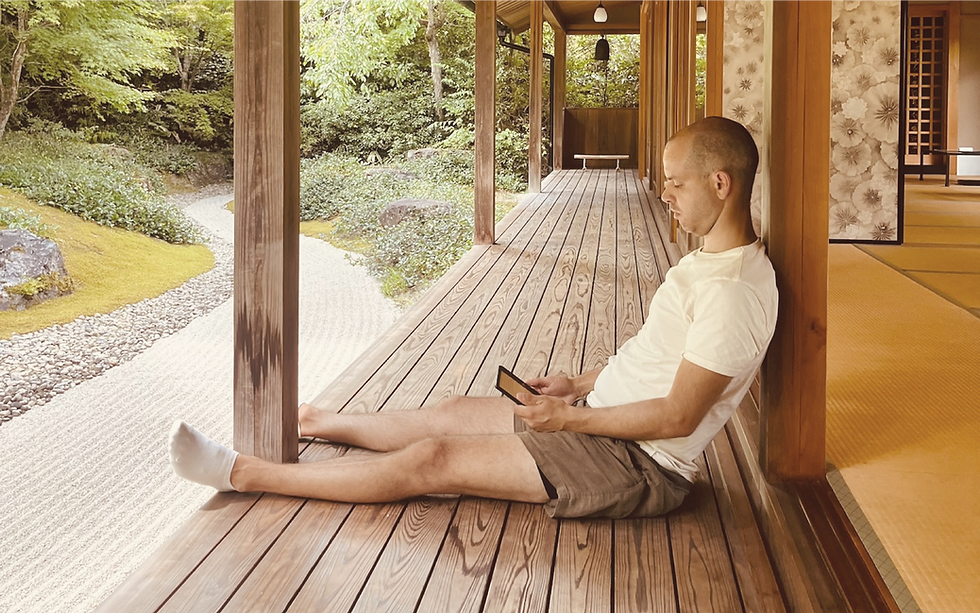
Enjoying my e-reader.
2. Set clear boundaries.
Here are some examples of boundaries that tend to work well:
No phones or laptops in the bedroom.
No screens after 10 p.m., except for reading.
Turn off all (non-essential) notifications. 99.9% are non-essential.
Have screen-free zones in the house.
Set clearly defined time-slots away to answer your emails or WhatsApp's instead of letting them dictate your pace at work or at home. According to a UC Irvine Study, it takes you an average of 23 minutes to get back to a task once interrupted.
3. Declutter your digital life (mainly, your phone).
All these actions have scientifically proven to limit phone use significantly:
Remove all unnecessary apps.
Don't upgrade your phone if not absolutely necessary or even use a "dumb phone" such as a Nokia 6300 4g. It saves you time and money (my iPhone SE is fantastic)
Don’t keep work email or Slack on your phone if you don’t absolutely need them (you don't).
No (or if not possible, a blocked) browser on my phone has been a game-changer, 99% of spontaneous searches are not urgent or necessary.
Turn your phone screen to black and white
Use tools like One Sec to add friction when opening distracting apps.
4. Social Media: a personal decision.
I don’t use Instagram, TikTok or Facebook. I don’t miss them. Everything truly useful such as actual (human) connection, inspiration, learning or information is available elsewhere. Ask yourself: what do I gain, and what do I give away? Even that “perfect recipe” pushed to you by the algorithm costs you minutes of your life you didn’t plan to spend. Trust yourself to know when it’s time to cook, to be creative, to go look something up. Be the author of your life, not just a consumer.
5. For families: lead by example.
Children mainly watch what you do, not what you say. If phones are always in your hand, they learn that’s normal. Set rules together. Protect your shared time. Give them boredom, it’s the birthplace of creativity.
And finally, let’s not become the fun police. There’s nothing wrong with laughing at a silly video or zoning out with a podcast. But choose it. Decide: “I’m going to watch funny pet videos for 20 minutes.” Then enjoy it. Conscious choice is what separates a tool from a trap.
We can't escape technology, but we can reclaim our agency. Your time is your life. Spend it like it matters.


Comments